
 IT
ITTorquer — Managed AWS Environments, without the Operational Weight of DevOps
Radix creates, updates, and monitors your application environments on AWS (containers, database, networking, domain) from a single management platform, with a repeatable process verified before every change.
Radix is a technology company with over 10 years of experience in Cloud Computing, DevOps, Artificial Intelligence, and web/mobile development. It designs serverless architectures, automates infrastructure with Infrastructure as Code, and integrates generative AI solutions. Radix is a member of the AWS Partner Network, with a specialization in data platform modernization.
Torquer is the internal operating engine Radix uses to deliver and manage cloud environments for multiple clients in parallel, maintaining the same standard of quality, security, and responsiveness for each one.
Every client gets a dedicated AWS environment — in their own account, never shared — built to measure (services, database, networking, domain) and maintained by Radix with tools that make every change predictable, verified, and reversible. It is not a pre-packaged bundle: every environment is composed to measure from a catalog of proven components.
One Account per Client
No infrastructure shared between different clients.
Every Change Verified
Every change is verified before being applied — no surprises in production.
Deploy Separate from Provisioning
Application updates without stopping the infrastructure.
Torquer applies anywhere a company needs to manage application environments on AWS — one or many — without maintaining a dedicated in-house DevOps team.
New Custom Application Environment
A company that needs to launch an app with a database, dedicated networking, and a custom domain gets a complete environment, composed by choosing only the components it needs, without having to design the infrastructure from scratch.
Scale: 1 or more containerized servicesMulti-Project/Multi-Environment Consolidation
A company with multiple applications or multiple environments (development, staging, production) manages all of them with the same creation, update, and observability process, each isolated but governed consistently.
Scale: dev/staging/prod, multiple projectsContinuous Application Deployment
Every service has its own pipeline that builds the image from the repository and deploys it to the cluster, so application releases don't require touching the underlying infrastructure.
Scale: frequent releasesEvery client environment lives in a dedicated AWS account, separate from every other client's. Radix operates and maintains the environments from a centralized management platform, with controlled and audited access to each account.
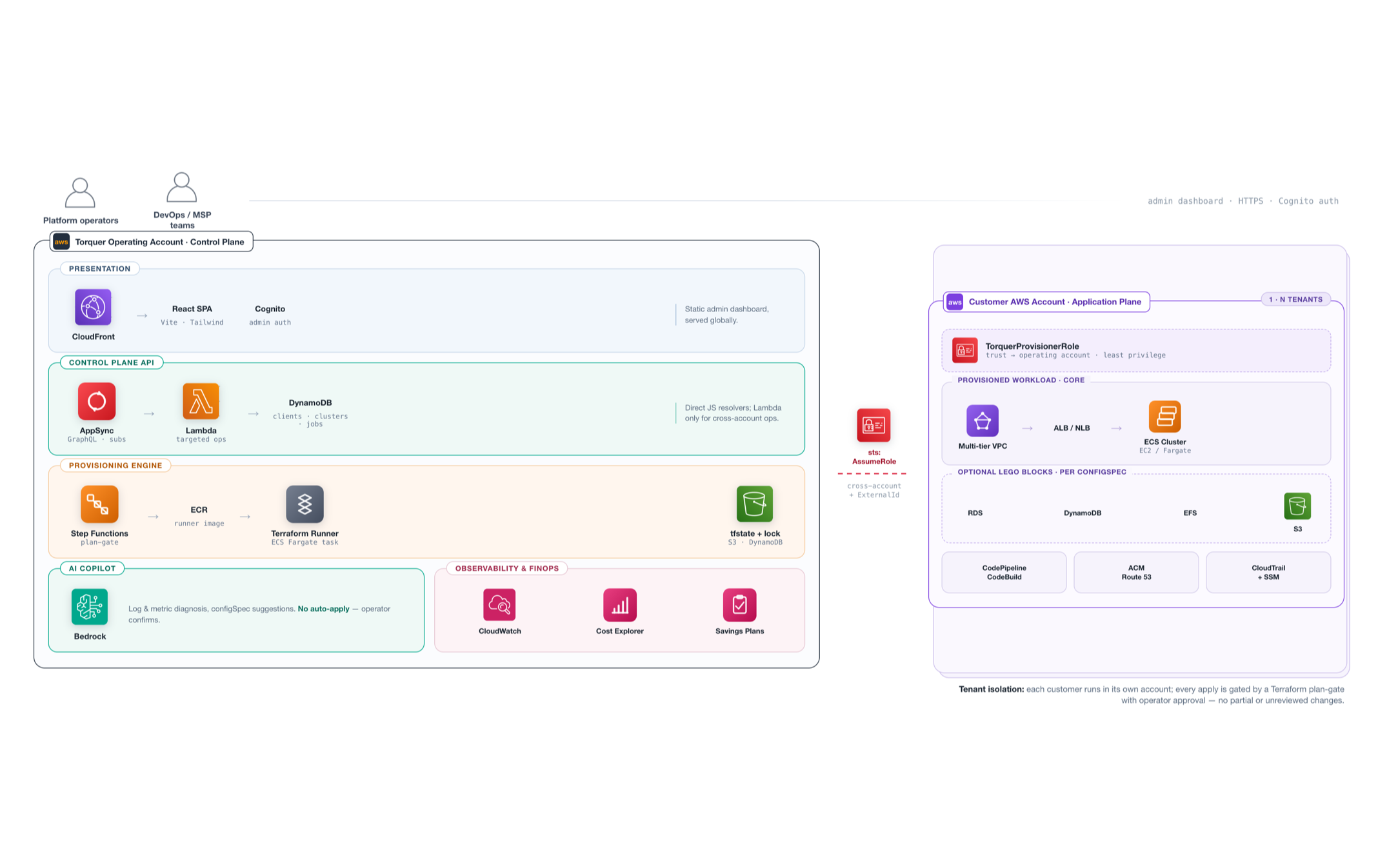
Control Plane - Centralized Management Platform
Centralized Management Platform: dashboard for creating, changing, and monitoring every client environment.
Provisioning Engine: applies every infrastructure change automatically and with full traceability.
Upfront Access Check: permission verification before any action on a client environment.
Change Preview and Approval: every significant infrastructure change is shown as a preview before being applied.
Centralized Observability: logs, metrics, and alerts centralized for Radix, viewable per client/project.
Application Plane - Dedicated Client Account
Modular Component Catalog: networking, containers, database, storage, domain, CI/CD, observability — each enabled only if needed.
Managed Container Environment: built on Amazon ECS, with automatic scaling.
Database and Storage: optional components, isolated per environment.
Domain and HTTPS: custom domain and managed HTTPS certificates.
Per-Service Pipeline: dedicated build and deploy for every application service.
Key Capabilities: Centralized management platform for creating, changing, and monitoring environments • Automatic, traceable provisioning engine • Upfront access check before every action • Mandatory preview and approval of significant changes • Modular component catalog enabled only as needed • Containers managed on Amazon ECS with automatic scaling • Optional database and storage isolated per environment • Custom domain and managed HTTPS certificates • Dedicated build and deploy pipeline per service • Centralized observability viewable per client/project
Torquer serves several profiles within the organization, each with specific needs from the control plane.
Companies without an In-House DevOps Team
They have applications to launch or maintain on AWS but don't want to hire or build in-house infrastructure expertise.
They want a ready-made, maintained environment — not an infrastructure project to run themselves.
Companies with Multiple Applications or Clients
Agencies, software houses, or companies with multiple products/projects that need isolated but consistently managed environments.
Consistency across environments, fast activation times for every new project.
Companies with Isolation and Cost Control Requirements
They don't want infrastructure shared with other clients, want to know exactly what's running in their own account, and want to be able to act on cost and capacity.
Dedicated AWS account, visibility across environments, and the ability to optimize compute costs over time.
Ideal Customer Profile: Has (or will have) containerized applications to run on AWS • Doesn't want to manage Terraform, CI/CD, and networking on their own • Requires full isolation from other clients (dedicated account) • Needs multiple environments (dev/staging/prod) managed consistently • Wants to be able to act on one environment (update, recreate, shut down) without stopping the others
Guided activation of the client's environment in their own AWS account, managed by Radix, with assisted composition of the required components (networking, containers, database, domain).
Phase 1: Discovery & Requirements (days 1–2)
Gathering the required application, services, databases, and domains.
Deliverable: agreed environment composition.
Phase 2: Environment Activation (days 3–6)
Setting up the environment in the client's AWS account, with access verification and a preview of changes before activation.
Deliverable: active and verified environment.
Phase 3: CI/CD and Domain Setup (days 7–9)
Connecting the application repository to the deployment pipeline and configuring the custom domain with HTTPS.
Deliverable: first application release published.
Phase 4: Testing and Go-Live (day 10)
End-to-end validation and transition to production.
Deliverable: operational, monitored environment, ready for future releases.
Timeline & Project Scope
Standard scope (1 application service, 1 environment): two weeks, from request to go-live.
Extended scope (multiple services, multiple dev/staging/prod environments, multiple domains): can be activated later on the same environment, without stopping what's already in production.
What's Included
Case Study: Billalo — multisite platform
Client: Billalo, an application that centrally manages content for multiple websites (events, artists, festivals, special projects), each with its own domain, branding, and custom theme, updatable from a single CMS.
Challenge
Every site requires its own public domain with HTTPS, and the two application services that make up the platform (content management backend and publishing frontend) need to scale and be updated independently, without manual infrastructure work for every new site or release.
Solution
A containerized environment on Torquer with the two application services configured on the same cluster, each with its own build and deploy pipeline; multiple domains — one for every site served by the platform — routed to the same environment with automatically managed HTTPS certificates; a dedicated database for the CMS.
Results
Get Started