
 IT
ITOceany — The Data Governance Layer for Companies with Data Everywhere
A single self-hosted deployment in your AWS account that unifies ERP, databases, files and SaaS into a governed data lake, exposed to AI agents and any MCP client.
Radix is a technology company with over 10 years of experience in Cloud Computing, DevOps, Artificial Intelligence, and web/mobile development. It designs serverless architectures, automates infrastructure with Infrastructure as Code, and integrates generative AI solutions. Radix is a member of the AWS Partner Network, with a specialization in data platform modernization.
Oceany is the intermediate layer that sits between business data sources and the systems that consume them: it consolidates data into a governed lakehouse and controls access to it through AI agents and an MCP server. It is not a BI tool, not a visual ETL, and it does not replace CRM/ERP: it is the single funnel through which every consumer accesses data, once.
Self-hosted in Your AWS Account
No data leaves the customer perimeter.
Native MCP
One single integration for BI, chatbots, IDEs, third-party agents.
Zero AWS Console Operations
Connectors, agents and MCP are managed from one single GUI.
Oceany applies wherever business data is fragmented across multiple systems and a single, governed point is needed to query it with AI.
ERP + Line-of-Business Consolidation
A company with a legacy ERP, a few line-of-business systems and SharePoint files unifies everything into an Iceberg lakehouse, queryable in natural language by a Bedrock agent.
Scale: 2–10 heterogeneous sourcesData Exposure via MCP
The Oceany deployment becomes an MCP server for Claude Desktop, Cursor, third-party agents and downstream BI suites, which integrate once and never touch the sources directly.
Scale: N external MCP clientsAI Assistant on Business Data
A non-technical user asks natural-language questions ("what is customer X's exposure?") and a Bedrock agent answers by combining lakehouse and operational data, with no queries and no IT involved.
Scale: any business teamOceany is installed as a single deployment in the customer's AWS account, operated by Radix cross-account. Everything that is Oceany — connectors, lake, agents, MCP server — runs inside the customer's perimeter.
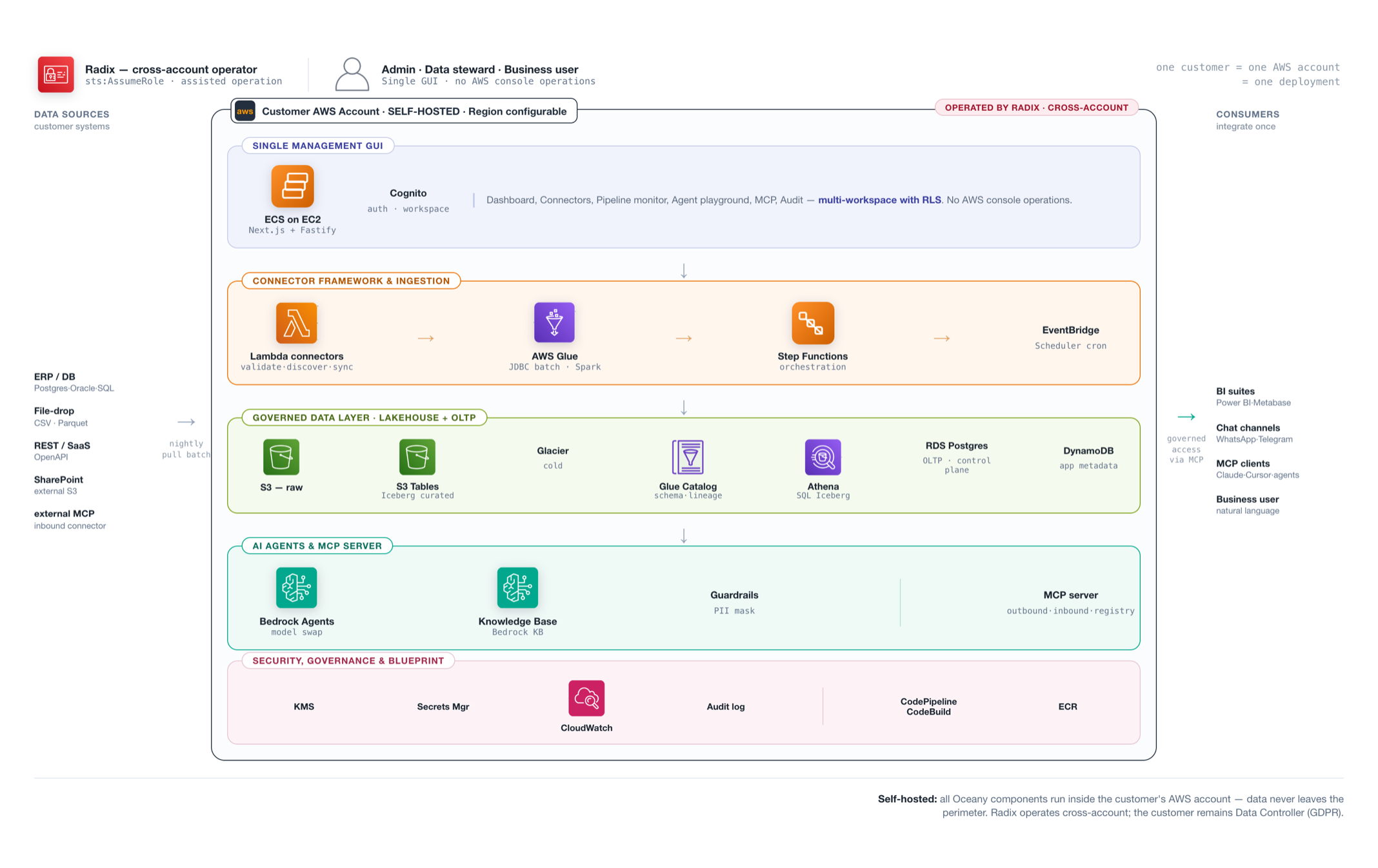
GUI & Governance - Centralized Management Platform
Single Management GUI: dashboard, connectors, pipeline monitor, agent playground, MCP and audit log.
Authentication and Access Control: managed through Amazon Cognito.
Catalog & Governance: schema, lineage and permissions on every dataset.
Immutable Audit: every operation, tool invocation and agent interaction is tracked.
Data & AI Layer - Ingestion, Lakehouse and Agents
Connector Framework: a validate → discover → sync pipeline across a catalog of file-drop, Postgres, MySQL, SQL Server, Oracle, REST, S3, SharePoint, and external MCP.
Hybrid Ingestion: scheduled pull for API-based sources, planned batch for raw databases.
Analytical Lakehouse: data consolidated and queryable with SQL-like queries, raw/curated/cold zones.
Operational Database: the Oceany control plane, application database and connected line-of-business systems.
AI Agents and MCP Server: model + tools + knowledge base + guardrails with swap and no redeploy; bidirectional MCP server (outbound for external clients, inbound as a connector, registry for tool routing).
Key Capabilities: No AWS console operations — everything self-service from the GUI • Multi-workspace with RLS isolation • API-first ingestion or Glue JDBC batch, incremental + periodic full reconcile • Iceberg lakehouse queryable via Athena, merge-on-read, predicate pushdown • Bedrock agents with model swap (Claude/Nova/Llama/Mistral) with no redeploy • Outbound MCP server with per-workspace tool/secret/rate-limit management • MCP registry for dynamic orchestration of external tools • Chat channels (WhatsApp Business, Telegram) as query interfaces • KMS encryption, Secrets Manager, audit log exportable to S3
Who Oceany is built for.
SMB & Mid-Market with Fragmented Data (50–500 People)
Legacy ERP, multiple line-of-business systems, SharePoint files, zero internal capacity to unify them.
They want a single, vertically-integrated product, not 12 tools to assemble.
Manufacturing company with multiple sites.
Organizations That Want to Expose Data via MCP
Already have BI, chatbot or downstream agents and want one governed access point.
OAuth 2.1, audit, granular per-workspace control.
BI suite with orchestrator agents consuming Oceany as the single source.
Companies with Data Residency and Predictable Cost Constraints
Don't want a central multi-tenant SaaS, need self-hosted with simplified GDPR (data never leaves the customer account).
Certain budget, no dependency on a third-party data vendor.
Regulated SMB handling sensitive or confidential third-party data.
Ideal Customer Profile: Data scattered across multiple systems (ERP, DB, files, SaaS) with no consolidation point • Needs natural-language queries on business data via AI agents • Data sovereignty requirement (self-hosted, nothing leaves their own AWS account) • Wants to integrate BI/chatbot/external agents once, not per source • IT budget compatible with a fixed, verifiable-cost cloud deployment
Guided activation of the Oceany deployment in the customer's AWS account, operated by Radix cross-account, with assisted configuration of connectors and agents. A fast path: from request to first operational agent in two weeks.
Phase 1: Discovery & Source Mapping (days 1–2)
Inventory of data sources and access permissions.
Deliverable: ingestion plan.
Phase 2: Environment & Connector Activation (days 3–6)
Deployment rollout and activation of core connectors (file-drop, Postgres/MySQL/SQL Server/Oracle, REST, SharePoint) via guided wizard.
Deliverable: operational ingestion pipelines.
Phase 3: AI Agents & MCP Setup (days 7–9)
Configuration of agents, knowledge base and outbound MCP server.
Deliverable: tested agent playground and MCP.
Phase 4: Testing & Go-Live (day 10)
End-to-end validation and production activation.
Deliverable: operational deployment with active audit.
Project Timeline & Scope
Standard scope: up to 5 connectors, 1 business team: two weeks, from request to go-live.
Extended scope: custom connectors, additional chat channels, tailored integrations: configurable at a later stage, without stopping operations already active.
What's Included
Case Study
Client: Space for a short client description.
Challenge
Space for the challenge description.
Solution
Space for the solution description.
Results
Get Started